

What are Eye Accessing Cues?
Eye Accessing Cues (EACs) are a concept from Neuro-Linguistic Programming (NLP). The idea is that a person’s eye movements may provide clues about the type of mental processing occurring at a particular moment—for example, visual memory, visual imagination, remembered sounds, constructed sounds, or internal self-talk.
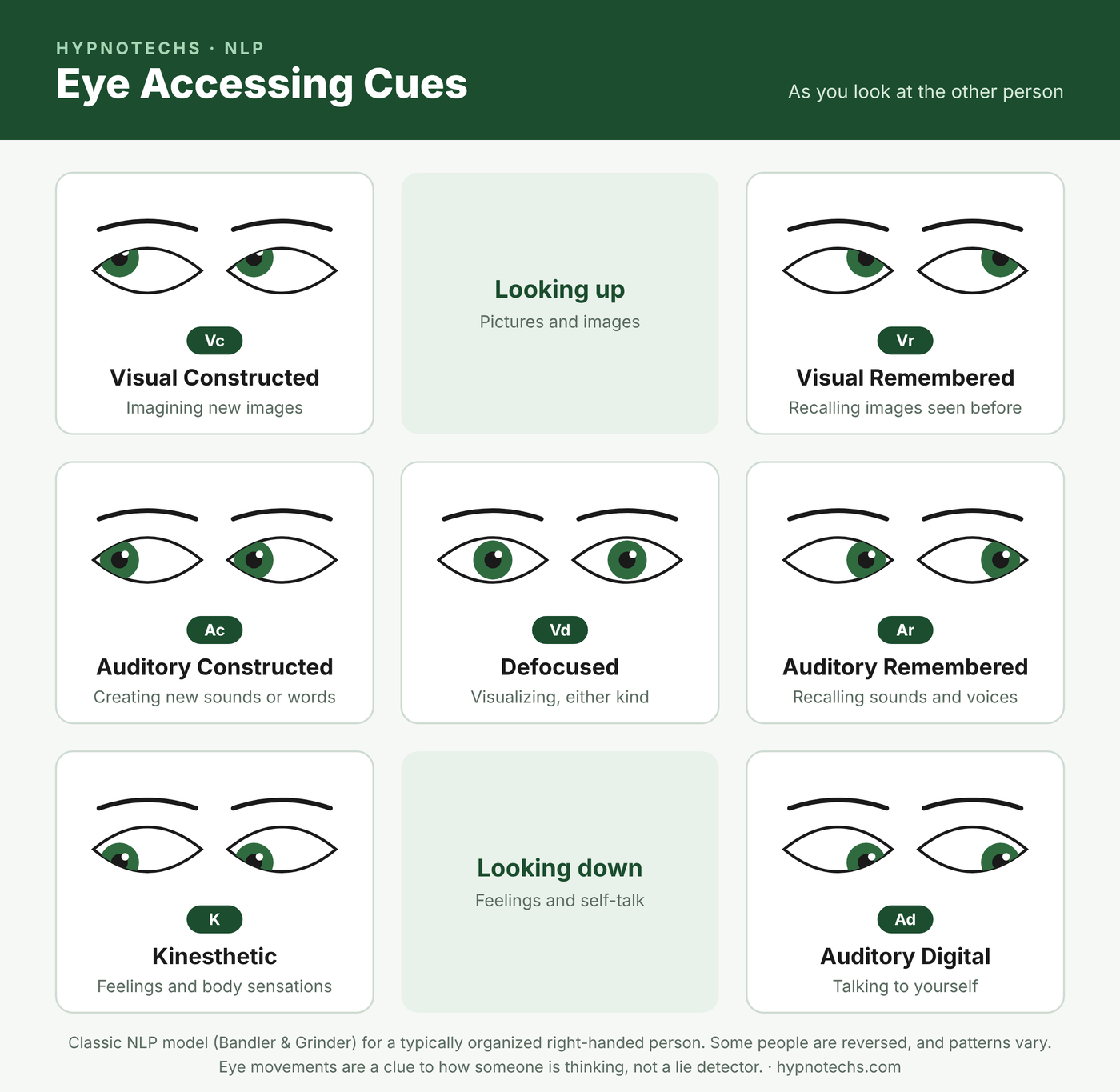
A common NLP model maps specific eye directions to specific kinds of thought. In the standard version, looking up and to one side is associated with remembered visual information, while looking up and to the other side is associated with constructed visual information. Horizontal movements are linked with auditory processing, and downward movements are often linked with internal dialogue or bodily feelings.
The model is usually presented as a practical way to infer how someone is thinking. However, research has not reliably supported the claim that eye direction can identify whether a person is remembering or constructing an image, sound, or idea.¹
What does the standard NLP model say?
The exact chart can vary, particularly depending on whether the observer is looking at the person or describing the direction from the person’s own point of view. A commonly taught version is:
Eye direction from the observer’s perspective | Common NLP interpretation |
|---|---|
Up and left | Visually remembered information |
Up and right | Visually constructed information |
Left | Auditory remembered information |
Right | Auditory constructed information |
Down and left | Internal dialogue or self-talk |
Down and right | Kinesthetic or emotional processing |
In this chart, “left” and “right” refer to the person’s visual field as seen by the observer. Some instructors reverse the labels or emphasize that the model should be calibrated to the individual rather than applied as a universal rule.
That qualification matters. Eye movements differ naturally among people, and a person may look away for many reasons unrelated to the mental category proposed by the model. They may be concentrating, searching for words, responding to social expectations, reducing distraction, or simply following a habitual movement pattern.
How is the model supposed to work?
The model is based on three main assumptions:
Thinking involves different sensory systems.
NLP describes thought in terms such as visual, auditory, and kinesthetic processing. For example, someone might picture an event, hear an imagined voice, or notice a bodily sensation.Eye movements accompany shifts in attention.
NLP training suggests that particular eye directions correspond to particular forms of internal processing.These movements can be observed externally.
By watching a person’s eyes, a practitioner is expected to infer what kind of mental representation the person is using.
In practice, an NLP practitioner might ask a person to remember the color of a childhood bedroom, imagine a different color, recall a familiar melody, or silently repeat a phrase. The practitioner then watches for recurring eye movements and attempts to establish an individual pattern.
The reasoning is more cautious when framed as observation rather than certainty: a practitioner may notice that a person looks in a particular direction during certain tasks. The problem arises when that observation is treated as proof of a specific thought process.
Is there scientific evidence that the cues work?
The strongest direct test of the classic claim found no meaningful support for it. Wiseman and colleagues examined whether eye movements predicted whether people were telling the truth or constructing a response, as the NLP model would suggest. Across several studies, the researchers found no evidence that the proposed eye-movement patterns reliably distinguished truth from deception or memory from fabrication.²
A later study tested the idea more specifically by asking participants to answer questions that required either recalling information or inventing it. The researchers again found no reliable relationship between the direction of eye movements and whether participants were remembering or constructing their answers.³
These findings do not show that eye movements never accompany mental activity. People do move their eyes while thinking, and visual behavior can change with attention, task demands, emotion, fatigue, and social context. The evidence does show that the standard NLP chart should not be treated as a validated method for identifying a person’s thoughts or detecting deception.
Why might the idea seem convincing?
Several factors can make Eye Accessing Cues feel persuasive:
People really do move their eyes while thinking
Eye movements are connected with visual attention and information processing. A person may look away while trying to remember something or solve a problem. That genuine behavior can be mistaken for evidence supporting a much more specific theory.
People vary from one another
A practitioner may observe a recurring pattern in one person. That pattern may be real for that individual, but it does not establish that the same eye direction has the same meaning for everyone.
The questions themselves influence the response
Different questions can produce different kinds of thought. Asking someone to picture an object is not the same as asking them to calculate a sum or describe an emotion. The person may also use several kinds of processing at once.
Confirmation bias can reinforce the interpretation
If a practitioner expects a particular eye movement, they may notice instances that appear to confirm the model and overlook movements that do not fit. The client may also interpret an ordinary movement as meaningful after being told what it supposedly indicates.
The model is easy to remember
A six-position chart is simple and appealing. Clear categories can feel useful even when the underlying relationship is weak or unsupported.
Can Eye Accessing Cues reveal whether someone is lying?
No reliable conclusion about lying should be drawn from Eye Accessing Cues.
The claim that looking in one direction indicates remembered information while looking in another indicates constructed information has often been connected with lie detection. Controlled research has not supported that use.² A single eye movement is not a dependable indicator of honesty, deception, memory, or intent.
Deception is a complex behavior. It can involve the content of a statement, the person’s goals, emotional state, relationship with the listener, perceived consequences, and the way questions are asked. No simple visual sign can reliably settle whether someone is telling the truth.
This point is important in workplaces, relationships, coaching, education, and legal settings. Using eye direction as evidence that someone is lying can create unnecessary conflict and unfair judgments.
Are Eye Accessing Cues the same as eye contact?
No. Eye Accessing Cues concern the direction or pattern of eye movement during thought. Eye contact concerns whether a person looks toward another person’s eyes.
Eye contact varies across cultures, relationships, situations, and individuals. Looking away may reflect concentration, politeness, discomfort, habit, neurodivergence, cultural norms, or the need to manage stimulation. Looking directly at someone does not prove honesty, confidence, or engagement, and looking away does not prove dishonesty or disinterest.
These behaviors should not be treated as interchangeable.
Do eye movements show what sensory system a person is using?
Not in the precise way proposed by the standard NLP model.
People can use visual, auditory, verbal, spatial, emotional, and other forms of processing during the same task. A person describing a memory may picture an event, hear remembered speech, evaluate its meaning, and experience related feelings. These processes may overlap rather than appear as separate, visible categories.
Eye movements can be studied as part of visual attention and perception, but that is different from claiming that a particular direction reveals a specific internal representation. The broader scientific study of eye movements uses controlled measurements and carefully defined tasks; it does not validate the familiar NLP chart simply because people look in different directions while thinking.
What does “calibration” mean in NLP?
In NLP, calibration usually means observing a person’s behavior in a particular context and looking for patterns that may help the practitioner respond appropriately.
For Eye Accessing Cues, calibration might involve asking questions that appear to require different kinds of mental activity and recording the person’s eye movements. The practitioner may then form a personal baseline rather than relying solely on a standard chart.
Calibration is more cautious than assuming that every person follows one universal pattern. Even so, calibration does not automatically establish what a movement means. A repeated behavior may correlate with a task without revealing the person’s exact thought process. To determine meaning confidently, the person’s own report and the context remain essential.
Can Eye Accessing Cues still be useful in coaching or communication?
They may be useful as a prompt for curiosity, provided they are not treated as a diagnostic or truth-detection tool.
For example, a coach might notice that a client looks away while considering a difficult question and allow extra time for reflection. That response can be respectful and helpful without assigning a fixed meaning to the eye movement. The coach could ask:
“What were you noticing just then?”
“Would you like a moment to think?”
“What came to mind when I asked that?”
“Would it help to describe the image, feeling, or idea you had?”
These questions give the person an opportunity to explain their experience instead of requiring the practitioner to guess.
The most defensible use is therefore observational and conversational: notice behavior, avoid overconfidence, and check your interpretation with the person.
What are better ways to understand someone’s thoughts?
Direct, respectful communication is more dependable than guessing from eye direction. Useful approaches include:
Ask open questions
Questions such as “What was that like for you?” or “What were you thinking about?” invite the person to describe their experience in their own words.
Use reflective listening
Briefly summarize what you heard and ask whether you understood correctly. This reduces the risk of treating an assumption as fact.
Consider context
A movement may have different meanings in a job interview, therapy session, classroom, family discussion, or casual conversation. Context changes behavior.
Observe patterns rather than isolated actions
One glance rarely provides meaningful information. Even repeated behavior should be interpreted cautiously and discussed rather than labeled.
Respect individual differences
People vary in attention, communication style, culture, disability, stress responses, and comfort with eye contact. A useful approach leaves room for those differences.
Is NLP itself scientifically supported?
NLP includes a wide range of techniques and claims, so broad statements about the entire field can be difficult to evaluate. Some methods associated with NLP overlap with general communication skills, goal setting, visualization, or other practices found in many forms of coaching and counseling. That overlap does not validate every distinctive NLP claim.
Reviews of NLP research have reported limited and inconsistent evidence for many health-related NLP claims, with concerns about study quality and the need for better research.⁴ The specific Eye Accessing Cues model has also failed direct experimental tests.² ³
A fair conclusion is that some people may find NLP exercises subjectively useful, but the standard eye-direction chart should not be presented as an established scientific method for reading thoughts, identifying sensory preferences, or detecting lies.
How should practitioners talk about Eye Accessing Cues responsibly?
A responsible explanation should:
Describe Eye Accessing Cues as an NLP model, not an established fact.
Avoid claiming that eye direction reveals a person’s thoughts.
Never use the model as a lie detector.
Avoid diagnosing mental or emotional states from eye movements.
Treat individual differences and context as important.
Ask the person what they experienced instead of assuming.
Explain the limits of the evidence when teaching or using the concept.
Protect the person from judgments based on ordinary behavior.
An upbeat, practical approach is still possible: eye movements can be an invitation to slow down, pay attention, and ask better questions. The value comes from respectful communication, not from assigning a fixed meaning to a glance.
What is the short answer?
Eye Accessing Cues are an NLP theory that links eye directions with different kinds of mental processing. The theory is easy to remember and may encourage careful observation, but controlled research has not shown that the standard eye-direction patterns reliably reveal whether someone is remembering, imagining, using a particular sensory system, or lying.¹ ² ³
Use eye movements as a reason to remain curious—not as proof of what another person is thinking.
Notes
Tomasz Witkowski, “Thirty-Five Years of Research on Neuro-Linguistic Programming. NLP Research Data Base. State of the Art or Pseudoscientific Decoration?” Polish Psychological Bulletin 41, no. 2 (2010): 58–66.
Richard Wiseman, Caroline Watt, Leanne ten Brinke, Stephen Porter, Stephen Couper, and Calum Rankin, “The Eyes Don’t Have It: Lie Detection and Neuro-Linguistic Programming,” PLoS ONE 5, no. 1 (2010): e4027.
Andrew M. J. Vrij, A. Mann, S. Leal, and P. Granhag, “The Eyes Don’t Have It: A Reprise,” Legal and Criminological Psychology 15, no. 2 (2010): 425–439.
Michael Heap, “The Validity of Some Early Claims of Neuro-Linguistic Programming,” Skeptical Inquirer 13, no. 3 (1989): 296–309.